Download the pdf guide here: AMBIANCE Overheating Guide.pdf
Reduce house overheating at the source
With indoor summer temperatures rising over the past 20 years, comfort, health and lower energy bills are strongly influenced by better envelope design. Openings are the most important element to get right, with orientation, glazing, frames and night purging all working together.
The 2022/2023 H1 Energy Efficiency amendments to the New Zealand Building Code lifted thermal standards, but there’s still room to refine them, especially where architects and builders adopt higher-performing frame materials and inboard/flush window installation.
Form factor and orientation, how buildings gain and lose heat, are fundamentals. Yet, here at Ambiance, we still see large south and west-facing windows on drawings, as if comfort and energy use rank second to views or street aesthetics.
These openings are major heat-loss holes in winter and heat-gain sources in summer, with real impacts on occupant well-being and running costs.
By the time we see the architectural drawings, the consent is often already approved and the opening design and location are effectively locked in for the life of the building. When they are not optimised for orientation, the building is working uphill on performance and energy efficiency from day one.
This article looks at the local evidence for increasing temperatures, findings by BRANZ and Auckland Council, and a framework for windows and doors to help specifiers optimise the envelope design to improve comfort and cost-of-living outcomes for New Zealand householders.
2025 BRANZ Research on indoor conditions
In March 2025, BRANZ released preliminary findings from the Household Energy End-use Project 2 (HEEP2), a landmark national study of energy use and indoor conditions in New Zealand homes.
Key findings from HEEP2 include:
Indoor summer temperatures have risen by 6%–10% over the past 20 years, translating to an increase of 1.3°C–2.1°C, depending on the room and time of day.
Average evening temperatures in both living rooms and bedrooms now exceed 24°C.
36% of the 310 bedrooms monitored were classified as ‘overheating’ using the CIBSE 1b Standard, over 26°C for more than 1% of night-time hours between 10pm and 7am.
One of the main insights is that more people feel too warm in summer than too cold in winter, indicating that overheating is now a more prevalent comfort issue than inadequate heating.
BRANZ Senior Research Scientist Vicki White noted: ‘Overheating homes are uncomfortable, can exacerbate health issues and impact sleep, and the issue is becoming more prevalent with climate change.’
Medium-Density Housing Crisis
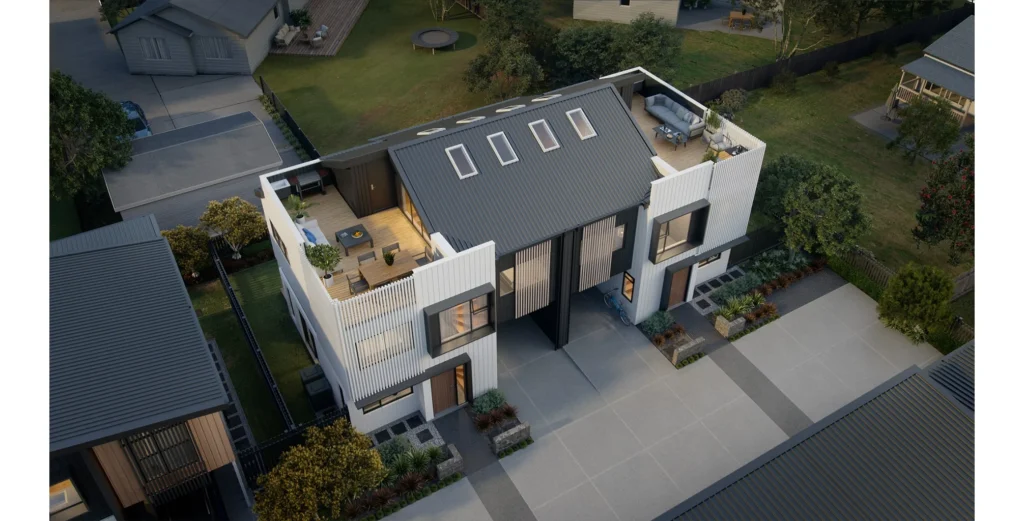
Medium-density housing (MDH) represents a significant and growing portion of the New Zealand building market. Recent Auckland Council studies have reported that residents of upper-level terraced homes and duplexes are experiencing summer overheating, resorting to using ‘fans, air conditioning, and keeping curtains closed, leading to increased energy costs.1
The design constraints inherent to this typology create a perfect storm for heat gain:
Shared walls limit opportunities for cross-ventilation.
Smaller sites reduce the potential for optimal window orientation.
Smaller sites reduce the potential for landscape cooling and external shading from mature trees.
Pressure to maximise floor area often results in large, glazed walls (particularly on north and west elevations) without adequate external shading devices.
Multi-level living means upper floors trap rising heat, with limited escape paths.
In this context, the specification of the building envelope, and specifically, the thermal performance of windows and doors, becomes the primary tool for preventing overheating.
When traditional passive design strategies (orientation, deep eaves, cross-ventilation) are constrained by site and typology, the glazing and frame specifications must do the heavy lifting.
Building.govt.nz guidance on ‘Designing for your climate’ describes how climate change is increasing the urgency of overheating mitigation. The report recommends:
Openable, securable windows, capable of allowing a high-volume flow of air for summer cooling.
Good solar control for windows, ideally including external movable shading for eastern walls, western walls, and appropriately sized overhangs for northern aspects.
The report also notes that individual sites can have microclimates that vary significantly from regional averages, meaning that architects may need to specify substantially more insulation and better glazing than required by the Building Code for exposed or shaded sites.
Three Steps to avoid overheating
Address overheating in priority order: first reduce solar gain through design, then through glazing specification, and finally manage any residual heat through ventilation.
1. Design
Start here, as passive design measures are the most cost-effective solution.
a) Orientation: First, try to orient the building, or large glazed elevations, away from the sun — particularly the west-facing sun, though east and north are also important.
b) Shading: Second, shade west-facing windows from low-angle sun, and north-facing windows from high-angle sun (and potentially the east as well). Options include eaves, overhangs, verandahs, planting,
louvres or fins.
c) Window size and material: If you can’t do either of the above, limit window and door sizes on elevations that will receive a lot of sunlight. Use an insulated frame to reduce heat transfer.
2. Glass and Frames
Once you’ve done all you can through design, if there are still large glazed areas facing the sun, you can look at glazing and frames.
a) SHGC: Use the windows’ SHGC (solar heat gain coefficient) to reduce how much heat the glazing lets in. Standard low-E glazing typically lets in about 55% of solar heat, but this can be upgraded to glazing that admits closer to 35%. This can make all the difference.
b) Frame material: The low thermal conductivity of uPVC material (approximately 0.17 W/mK, compared
with 160 W/mK for aluminium) dramatically reduces heat transfer. The frame remains cool to the touch
even on hot days, preventing it from contributing to internal heat gain. This is the technical basis for the ‘insulated frame’ advantage where the frame is not a thermal bridge.
3. Ventilation
Once you’ve done all you can to prevent heat from entering the home, it’s time to look at ways to purge heat once it’s inside.
a) Manual/passive (‘cross-flow’) ventilation: Ensure you have secure openable windows or doors at either end of a room so you can open both and flush out warm air. It doesn’t always work, particularly if there’s no wind.
b) Mechanical ventilation:
i. Continuous mechanical extraction: Essentially a fan that runs continuously, extracting warm air. Great in summer, less so in winter.
ii. Balanced heat recovery (MVHR/HRV): It improves indoor air quality and winter efficiency, but it isn’t a cooling system. Summer bypass helps avoid heat recovery, yet airflow is usually too low to purge heat alone. It’s better to manage overheating with design, glazing, shading and (where possible) night purging.

Ambiance uPVC systems and what to expect
Using a naturally thermal-resistant, multi-chambered frame such as uPVC, together with inboard/flush installation, improves envelope performance.
This contrasts with the traditional New Zealand method of face-fixing windows and doors, where unwanted heat enters.
The Ambiance uPVC frame has the following attributes:
Flexible glazing options: Standard Low-E (SHGC ~ 0.50) and low solar gain (SHGC ~ 0.35) insulated glazing units (IGUs) can be specified by elevation, allowing architects to fine-tune solar control across the building envelope.
Thermally non-conductive frames: With R-values in the range of R0.7 – R0.8, Ambiance uPVC frames effectively minimise thermal bridging, keeping the frame cool in summer and warm in winter. This is a measurable performance advantage over both standard and thermally broken aluminium.
Integrated ventilation solutions: European-style tilt-and-turn functionality enables secure night purging and controlled cross-ventilation, essential for heat removal in MDH where window placement may be constrained.
Acoustic performance: uPVC frames can reduce noise transmission by up to 35 dB, an important co-benefit in higher-density urban environments.
For architects and specifiers, uPVC represents a shift from component-based thinking to integrated envelope performance. Specifying a high-performance building envelope helps to achieve greater thermal comfort year-round, reduce operational energy, and meet the expectations of increasingly informed house buyers and tenants.